Is it ethical for a therapist to use AI for marketing?
Yes, with the right guardrails. The ethics issue with AI in clinical practice is the use of client data: feeding session notes, intake forms, or any identifiable client information into a model. That is not what Ariadne does. Ariadne writes marketing content (Google Business posts, social drafts, referral outreach, blog posts) using only information about your practice in the abstract: specialties, modalities, ideal client demographics, geography, availability. No client data ever enters the system. The content output is yours to review before anything publishes, so the ethical responsibility for what reaches the public is still yours, where it should be.
What if the content doesn't sound like me?
This is the first thing most therapists worry about, and the honest answer is that the fit is close from the start and gets closer every week. Ariadne builds a voice profile from your own writing samples and your website, so the first drafts already carry your warmth, rhythm, and vocabulary rather than a generic marketing tone. When something is not quite right, you edit it, and those edits are the strongest signal the platform has: it reads them and tunes to them. Most therapists see the fit tighten noticeably by the second week, to the point where the drafts need little more than a glance. The voice is the whole product, so if it ever sounds off, that is a bug we want to hear about, not something you have to live with.
Does this work for LMFTs, LCSWs, and psychologists, or just LMHCs?
It works for any licensed mental health professional in private practice. LMHCs, LMFTs, LCSWs, licensed professional counselors (LPCs), psychologists, and psychiatric nurse practitioners all face the same core marketing constraints: no soliciting testimonials from clients, no outcome guarantees, no diagnostic claims about non-clients, and the same discomfort with self-promotion that comes from a career built around helping people rather than selling to them. Ariadne is calibrated to those shared constraints, and the voice profile adapts to how you specifically write, regardless of license type. Darla happens to be an LMHC, but nothing about the platform is specific to that license.
Can Ariadne ask my clients for Google reviews?
No. The therapist version of Ariadne does not include review-request emails, by design. Most state licensing boards treat the solicitation of reviews from current or former clients as a dual-relationship and undue-influence violation. The small-business version of Ariadne does include review-request emails, because that is appropriate for photographers, massage therapists, plumbers, and most other small businesses. The therapist version excludes the feature entirely. There is no way to enable it.
Will any client information enter the platform?
No. Ariadne does not ask for client names, intake notes, session content, diagnoses, or anything that would qualify as protected health information. The onboarding asks about your practice (specialties, ideal client in the abstract, modalities, geography, availability), your voice (writing samples that are yours, not your clients), and your marketing channels. Nothing about any individual client is requested or stored. If you ever paste something that resembles client information into a content prompt, you should remove it. The platform does not need it and does not want it.
What if my state board has rules that differ from the national norm?
Most state-level rules are stricter versions of the same themes: no outcome guarantees, no testimonials from clients, no diagnostic claims about non-clients, no language that creates a treatment relationship through the marketing itself. Ariadne is calibrated to the conservative end of those rules, which means the output will be compliant in virtually every state. If your state has a specific rule that goes further (some have explicit rules about telehealth advertising, scope-of-practice claims, or specific terminology), you can add that constraint in your practice settings and Ariadne will respect it across all future content.
How long does the weekly review actually take?
Most therapists spend fifteen to thirty minutes once a week reviewing the content Ariadne has drafted for them. The drafts are organized by day of the week, so the typical pattern is to open the calendar view on a Sunday evening or Monday morning, read through the week, edit anything that does not sound quite right, and either schedule the posts or save them to publish manually. Once your voice profile is dialed in (usually after the first two or three weeks of edits), the review time drops because the drafts need less editing.
How is this different from a general marketing tool or a virtual assistant?
A general marketing tool like Buffer or Later schedules posts you have already written. It does not write anything for you. A virtual assistant can write content but does not know clinical ethics, board rules, or how a therapist actually speaks. Ariadne is the only tool that does both: it writes the content in your voice, and the constraints of clinical private practice are built into the platform so the output respects them by default. The practical difference is that you get the leverage of automation without the risk of a board complaint from something a less specialized tool would happily produce.
What about the AI social media tools built for local businesses in general?
There is a whole category of AI tools now that learn a brand voice from your website and auto-post to every channel: Instagram, Facebook, LinkedIn, Google Business, and more. They are built for the widest possible market, which means clinical practice is an afterthought at best. A few things they tend to get wrong for therapists specifically: they suggest content types that would raise a board complaint (before-and-after showcases, engagement-bait questions, client-story-style posts), their ethics language is usually a vague "HIPAA-friendly" hedge rather than a hard rule that no client data ever enters the system, and their channel list stops at social scheduling: no referral-network CRM, no long-form SEO blog, no Facebook-group posts tuned to each group's own rules. Ariadne is built the other direction: narrow on purpose, for one profession's actual constraints, with the channels that profession actually uses.
Why not just use ChatGPT myself?
You can, and some therapists do. The difference is what happens every week after the first one. ChatGPT starts over each session: you re-explain your practice, your voice, and your ethical constraints every time you prompt it, and it has no memory of what you edited last week or why. Ariadne builds a voice profile once, learns from every edit you make, knows the clinical-ethics rules that apply to your license by default, and hands you a full week of content (Google Business post, social draft, referral outreach, plus a monthly blog post) already organized by day, without you writing a prompt at all. If you have the time to prompt-engineer a general chatbot every week and remember your own board rules while doing it, that works. Ariadne is for therapists who would rather spend that time with clients.
I am not tech-savvy. Is this going to be hard to use?
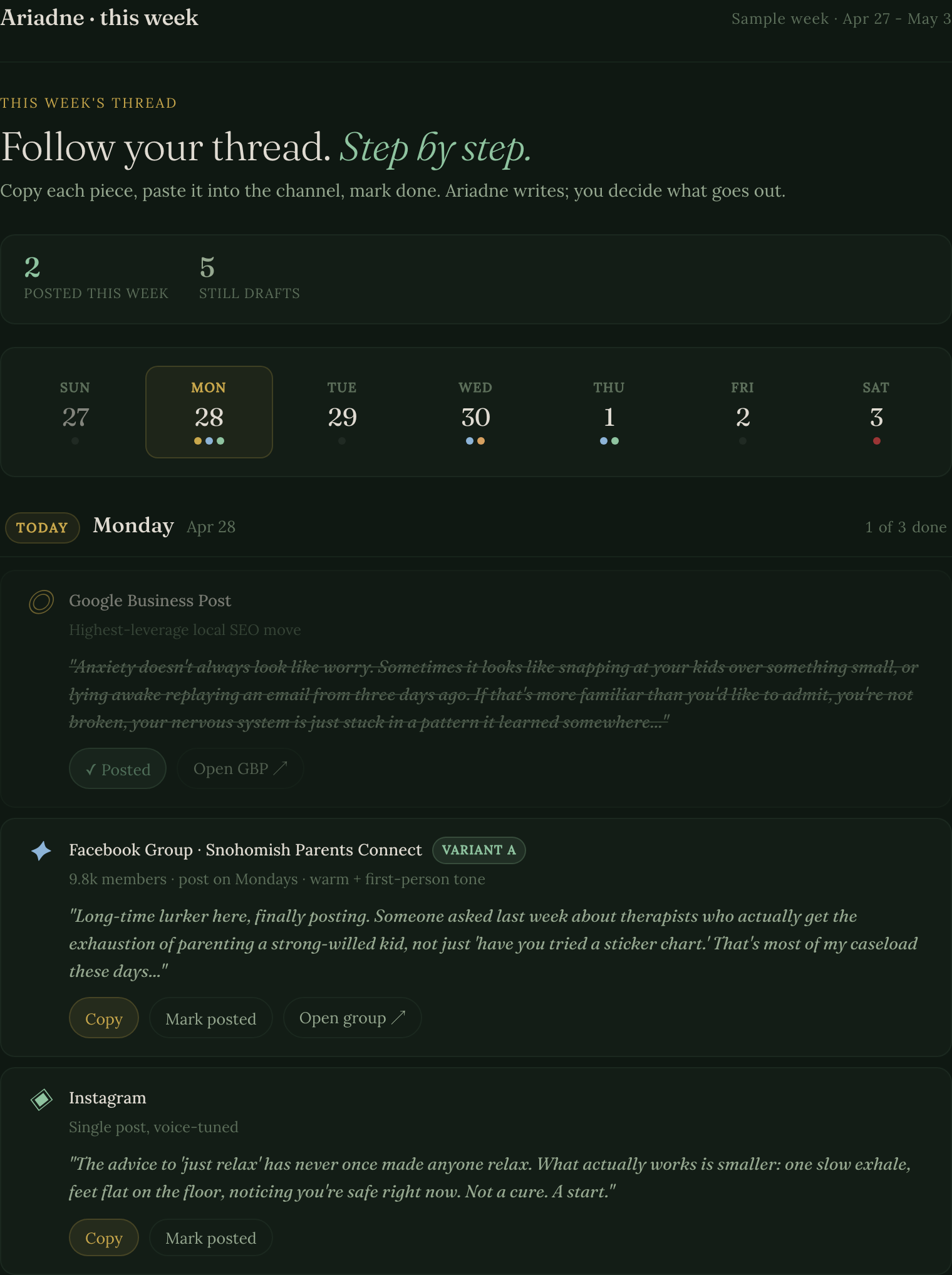
The platform is built to be readable by someone who has never used marketing software before. The onboarding is seven steps, each one a clear question with examples. The weekly content view is a simple calendar with posts laid out by day. There is no scheduling logic to learn, no integrations to set up, no plugins. If you can read email and copy and paste, you can use Ariadne. And if you ever get stuck, [email protected] goes to a real person (Bryan), not a chatbot.
Can I cancel any time?
Yes. Cancellation is a single button inside the app. No email to support, no retention call, no five-step flow to talk you out of it. If you cancel mid-cycle you keep access until the end of the billing period. If something is not working, we would rather you tell us so we can fix it, but we will not get in your way if you want to leave.
What happens to my content if I cancel?
Nothing is deleted. Everything Ariadne has ever drafted for you (posts, blog drafts, referral emails, your voice profile) stays attached to your account. If you resubscribe later, it is exactly where you left it. Cancelling stops billing and stops new weekly generation; it does not erase your history.
Why is there no free plan?
Because a real week of content, in your actual voice, costs real generation time to produce, and a permanently free tier would mean either throttling that quality or subsidizing it in a way that eventually shows up in the price for everyone else. Instead there is a full seven-day free trial with no credit card required: you get a real week of drafts before you decide, not a stripped-down preview.